
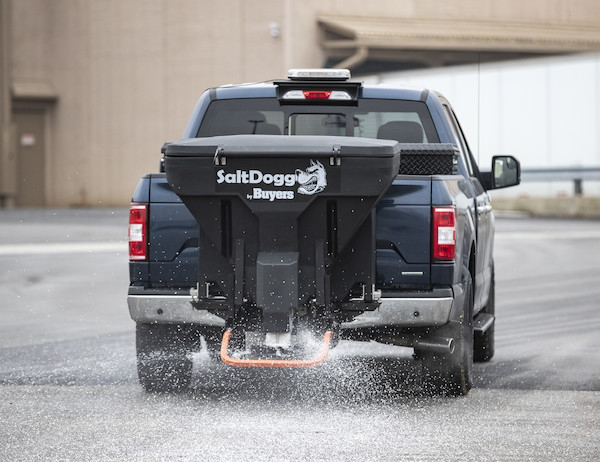
When winter weather arrives, having the right equipment can make all the difference in keeping parking lots, access roads, driveways and commercial properties clear and safe. For snow removal contractors, property maintenance companies and municipalities, a pickup truck salt spreader can be a practical addition to a winter maintenance setup.
But with different spreader styles, capacities and power options available, how do you choose the right salt spreader for your pickup truck?
The best option depends on the size of the areas you maintain, the type of de-icing material you use, how frequently you operate and your truck’s capabilities. Understanding these factors will help you select a spreader that fits your operation and supports your winter maintenance needs.
Choose Between a Tailgate Spreader and a Hopper Spreader
One of the first decisions when choosing a truck salt spreader is determining which style best suits your application. Tailgate and hopper spreaders both distribute de-icing materials, but they differ in capacity, installation and intended use.
Tailgate Salt Spreaders
Tailgate spreaders mount at the rear of a vehicle utilizing the vehicles receiver hitch to mount the spreader, making them an option for operators who need a compact solution for applying salt or other compatible materials. Depending on the model, a tailgate spreader may be suitable for residential properties, smaller commercial parking lots, sidewalks and other light-duty winter maintenance applications.
The SaltDogg tailgate spreader lineup from Buyers Products includes models designed for different vehicle classes and applications. For example, the TGSUVPROA has a 4.4-cubic-foot capacity and is listed for use with SUVs and half-ton, three-quarter-ton and one-ton trucks. Other models, such as the TGS03, offer an 8-cubic-foot capacity for commercial applications.
When comparing tailgate salt spreaders, consider the available capacity, mounting requirements, compatible materials and the size of the area you need to treat.
Pickup Truck Hopper Spreaders
Hopper spreaders sit in the truck bed and generally offer greater material capacity than compact tailgate models. They may be a better fit for contractors and property maintenance teams covering multiple sites or larger areas throughout a winter shift.
SaltDogg offers pickup truck and UTV hopper spreaders in a range of capacities and configurations, including electric poly hopper models.
When evaluating a hopper spreader, consider how much material you need to carry, how frequently you can refill and how the loaded spreader will affect your truck’s available payload. A larger hopper may reduce refill stops, but its capacity must be appropriate for the vehicle and application.
Which should you choose? A tailgate spreader may suit smaller jobs or operations where a compact setup is preferred. A hopper spreader may be worth considering when higher material capacity is a priority. Your workload, vehicle specifications and material requirements should ultimately guide the decision.
Determine the Right Salt Spreader Capacity
Choosing the right salt spreader capacity is about more than selecting the largest hopper that fits your truck. The goal is to carry enough material to complete your work efficiently without exceeding your vehicle’s weight limits. Start by considering the following questions:
How much area do you maintain? A small parking lot will have different material requirements than a portfolio of commercial properties or a longer maintenance route.
How often will you need to refill? Greater capacity may reduce trips to reload, depending on your application rate and route.
What material will you use? Salt, sand and blended materials can differ in density, which affects how much a spreader can carry by weight.
What can your truck safely carry? Account for the spreader, its loaded material, passengers, tools and any other equipment.
Always check your truck’s payload and axle ratings alongside the spreader’s specifications. The spreader’s volume capacity does not tell you how much material your vehicle can safely transport. For example, a spreader with a larger hopper may provide more volume, but a dense material such as rock salt can reach weight limits before the hopper is full. Matching capacity to both your workload and vehicle is essential. Our parts representative have years of experience and are experts at determining what is the best fit for you.
Understand Your Spreader's Feed Mechanism and Power Source
Beyond capacity and spreader style, the feed mechanism and power source can affect which equipment is suitable for your operation.
Electric Spreaders
Electric spreaders use an electric motor to operate the spreading system. They are available in various SaltDogg tailgate and hopper configurations, offering options for different vehicle classes and workloads. When comparing electric spreaders, consider the model’s capacity, electrical requirements, controls and intended duty cycle. Make sure your truck’s electrical system and the required installation are suitable for the selected equipment.
Hydraulic Spreaders
Hydraulic spreaders use a hydraulic power source to operate their spreading mechanisms. They may be suitable for vehicles already equipped with the appropriate hydraulic system or applications where a hydraulic configuration is preferred. Compatibility with the vehicle’s hydraulic system, flow and pressure requirements must be confirmed before installation.
Gas Powered Spreaders
Gas-powered salt spreaders are another option for pickup truck applications. While they are less common today as electric spreader options have become more widely used, they may still be worth considering for certain setups and operating requirements. As with any spreader, consider the maintenance requirements, intended application and compatibility with your vehicle when deciding which power source is right for your operation.
Auger vs. Conveyor Feed Systems
The spreader’s feed mechanism also matters, particularly when handling different materials. An auger moves material toward the discharge system using a rotating screw. A conveyor system transports material through the hopper using a moving chain or belt arrangement, depending on the design. SaltDogg offers models with auger and pintle chain conveyor configurations. The right option depends on the materials being applied and the manufacturer’s specifications for the individual spreader. Rather than choosing a mechanism based on its name alone, compare the approved materials, operating requirements and intended application of the models you’re considering.
Make Sure Your Salt Spreader Is Compatible With Your Pickup Truck
Before purchasing a pickup truck salt spreader, confirm that the equipment is appropriate for your specific vehicle. Truck compatibility involves more than whether a spreader physically fits. Consider the following:
Vehicle class and configuration: Confirm the manufacturer’s vehicle recommendations and any model-specific restrictions.
Payload and axle ratings: Include the spreader, material, occupants, accessories and other cargo when assessing the truck’s weight limits.
Mounting requirements: Check the required mounting hardware, available space and installation instructions.
Electrical or hydraulic requirements: Ensure your vehicle can support the selected spreader’s power system.
Access and visibility: Consider access to the truck bed, tailgate operation, rear visibility and any equipment that could interfere with installation or use.
If you’re planning to combine a spreader with a pickup truck snowplow, assess the complete setup rather than each attachment independently. The combined equipment and payload must remain within the vehicle’s applicable limits. Falcon Equipment can help you explore snow and ice equipment options and identify the compatibility requirements to consider when configuring your truck.
Plan for Cleaning and Maintenance
Winter conditions can be demanding on snow and ice equipment. Regular cleaning and maintenance help keep your salt spreader ready for use throughout the season. De-icing materials can leave corrosive residue on equipment, while moisture and material buildup can affect components and the movement of material through the spreader. Follow the manufacturer’s maintenance instructions, paying particular attention to:
- Cleaning the hopper and material-contact surfaces after use, as directed.
- Inspecting electrical connections, wiring and controls on electric models.
- Checking the feed mechanism, spinner and other moving components.
- Inspecting mounting hardware and connections.
- Following the recommended procedures for storage between uses and at the end of the season.
- Refer to the owner’s manual for the specific model’s cleaning, inspection and maintenance requirements. Proper care is especially important when equipment is used frequently throughout the winter.
Pair Your Salt Spreader With The Right Snow Plow
For many contractors and property maintenance operators, a salt spreader is one part of a complete winter maintenance setup. A snowplow removes accumulated snow, while a spreader applies salt or other compatible materials to help manage slippery conditions. Used as part of an appropriate winter maintenance plan, these tools can help operators address changing conditions across parking lots, access roads and commercial properties. If you’re choosing equipment for a pickup truck, start by assessing the jobs you’ll perform, the areas you’ll maintain and the capabilities of your vehicle. Our guide to choosing the right snowplow covers additional considerations, including blade types, sizing and truck compatibility.
Find the Right Salt Spreader for Your Pickup Truck
Choosing the right salt spreader starts with understanding your workload, material requirements and vehicle capabilities. Whether you’re considering a compact tailgate spreader for smaller properties or a higher-capacity hopper spreader for more demanding routes, the right configuration should match the work you need to complete.
Buyers Products’ SaltDogg line offers a variety of spreader styles and configurations for different winter maintenance applications.
At Falcon Equipment, we provide sales, rentals, service and parts support for snow and ice equipment, including salt spreaders and snowplows of all sizes. Our team can help you explore your options and determine what to consider when selecting equipment for your operation.
Looking for a salt spreader for your pickup truck? Explore Falcon Equipment’s plows and spreaders or contact our team to discuss your winter equipment needs.